Six AI leaders sign White House pledge for layered audits
Each company should run frontier models through four layers of controls and audits, including outside auditors and board committees, the signed text shows.
Share
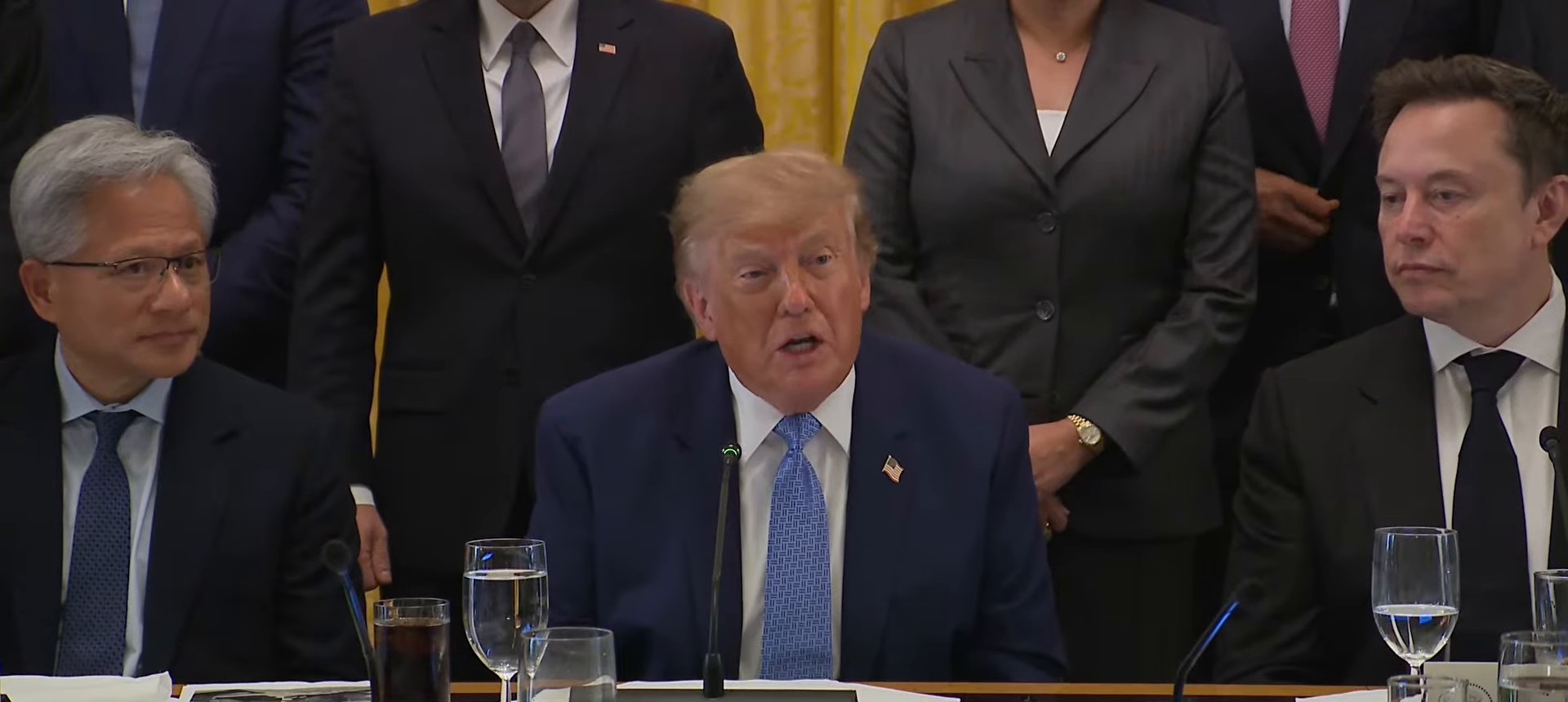
President Donald Trump and the leaders of six AI companies on Tuesday signed a one-page “White House Accord on Super Intelligence,” which says each company should run its frontier models through “four layers of controls and audits,” according to the signed text the White House released.
Asked whether it was binding, Trump said, “I think it’s morally binding,” CBS News reported. The Associated Press called it “a voluntary accord that will include internal and external reviews of the technology.” The text sets no penalties and names no one to enforce it.
The White House’s Rapid Response 47 account posted the signed document on X at 4:49 p.m. CT, after a White House lunch with tech executives. CBS and NBC News reported that Trump also posted it on Truth Social. As of 6:47 p.m. CT, whitehouse.gov had no text, readout or fact sheet on the accord.
What it says
The accord, subtitled “Joint Commitment on Frontier Responsibilities,” says “every company is responsible for developing its own technology safely.” It then lists four layers:
- Internal controls to monitor models’ capabilities and alignment “during training and deployment around areas like cybersecurity, biosecurity, and chemical threats,” and to ensure the models “do not hack or access technical systems in unintended ways.”
- An internal team to make sure the controls, monitoring and detection “are operating as intended” and that problems are fixed.
- “An independent external auditor or evaluator” to assess whether those controls work.
- “An independent committee of the board of directors” to oversee the teams and receive reports from them and from the auditors.
The companies “will meet regularly to establish standards and best practices to improve the safety of their systems,” the text says.
It leaves law for later. “Over time, it may make sense to codify these steps into laws or regulations,” the text says. “Regardless of whether this is required of companies, we believe that implementing these controls and audits is critical to ensuring a safe future for everyone, and each of our companies are committed to doing this.”
Who signed
The signature page lists Google CEO Sundar Pichai, Anthropic CEO Dario Amodei, Meta CEO Mark Zuckerberg, OpenAI President Greg Brockman, Elon Musk for xAI and Nvidia CEO Jensen Huang, alongside Trump.
Amazon founder Jeff Bezos and Microsoft CEO Satya Nadella attended the lunch, AP reported, but neither name is on the signature page. Vice President JD Vance, Treasury Secretary Scott Bessent and House Speaker Mike Johnson also attended, AP said.
Johnson called the accord a “joint commitment” and a “statement of principles” on “super intelligence,” CBS reported. That is Trump’s preferred term for AI. He signed an executive order on Tuesday telling the executive branch to use it, according to a White House fact sheet.
Who it covers
The text speaks to “every company that is training and deploying frontier models,” but only the six companies’ leaders signed it. It does not name an auditor, set a deadline or say whether any audit results will be made public.
“I think I’m seeing tremendous self-policing, and they understand that they have to self-police,” Trump said, according to CBS. He said there was widespread agreement on “self-regulation” by the developers, “and we automatically have regulation with the Department of Justice, the FBI, all of that,” AP reported. He also said the companies have an incentive to police themselves and each other because “their companies are at stake,” according to CBS.
Zuckerberg called the accord “a start and an accord that the whole industry could come to,” NBC News reported. “I think that these are good steps forward,” he told reporters.
Committee and czar
Trump said the executives discussed forming a 10-person committee to “watch over the enterprise,” CBS reported. CBS’s account does not say who would sit on it or what powers it would have.
Trump also said he plans to name an “AI czar” in the next three or four days, according to CBS. Axios reported that he wants to check in with Johnson and Senate Majority Leader John Thune on the pick.
No pause
Nothing in the text pauses or slows development. “We do not need a moratorium,” Johnson said on Fox Business on Monday, according to NBC News. “We do not need to jump in and hyperregulate this, because we’ll lose the race to China,” he said.
Earlier Tuesday, at the unveiling of the government’s America.gov chatbot, Trump said, “I will never stifle the growth of a technology that will be bigger than the industrial revolution,” AP reported.
That puts him at odds with some of his guests. Amodei called this month for leading firms to slow down, and Musk and OpenAI CEO Sam Altman have called for letting safety measures catch up, AP reported.
On the record
“There’s no conflict between innovation, technology and safety,” Huang said Tuesday, according to CBS.
Altman told CNBC, “We are pacing our progress, which includes sometimes not training a model,” AP reported. OpenAI halted the rollout of a new model over safety concerns on Monday, AP said.
Sen. Mark Warner, D-Va., called for Congress to require testing, evaluation and incident reporting for the most advanced models, CBS reported. “The president’s response? To rename it and tell the companies developing it to regulate themselves,” Warner said.
What to do differently
Founders: The text asks companies that train and deploy frontier models to run these checks, and only the six signers have committed. It says nothing specific about startups that build on their models.
Parents: Nothing changes today. The accord adds no product rules for children and gives you no way to file a complaint.
Workers: Nothing in the text addresses jobs.
What’s next
- Whether the White House posts the text on whitehouse.gov, and whether Amazon, Microsoft or other frontier developers sign.
- Who fills the 10-person committee and the czar role, and whether either has any authority.
- Which auditors or evaluators the companies hire, and whether any results are made public.
- Whether Congress takes up mandatory rules like the ones Warner wants. Johnson has said no moratorium.
Earlier coverage
— Simone Adler
Edition Sept. 29, 2026 · Archive shelf