Newsom signs 13 AI bills, limiting AI-driven firings
Starting Jan. 1, 2027, employers can’t use AI to read workers’ emotions or collect their neural data; the firing rule starts July 1, 2027.
Share
7 sources
- Office of the Governor — Release on AI framework and worker protections (Sept. 30, 2026)
- Office of the Governor — Signing message, AB 1331 and AB 1883 (Sept. 30, 2026)
- Office of the Governor — Veto message, AB 2656 (Sept. 30, 2026)
- California Legislature — SB 947 (McNerney), enrolled text
- California Legislature — SB 951 (Reyes), enrolled text
- California Legislature — AB 1883 (Bryan), enrolled text
- California Legislature — AB 1331 (Elhawary), enrolled text
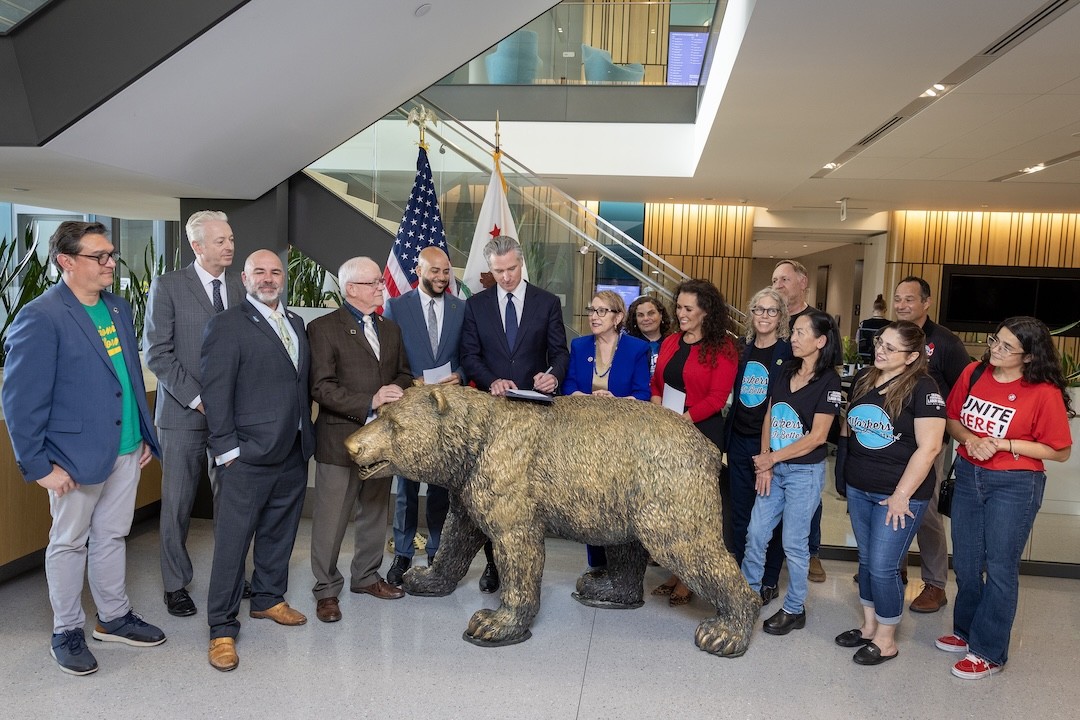
California employers will need a human to check AI-driven firing and discipline decisions, and they may not use AI surveillance tools to read workers’ emotions or collect their neural data. Gov. Gavin Newsom signed those rules into law Wednesday in a package of 13 AI bills, his office said.
Four of the bills cover the workplace. In a separate list, he vetoed a fifth workplace AI bill aimed at public agencies. His office calls the worker bills “first-in-the-nation,” a claim we did not independently test.
“AI should expand opportunity – not come at the expense of workers and families,” Newsom said in the release.
The four rules
SB 947, by Sen. Jerry McNerney (D-Pleasanton): a human behind AI firings. Starting July 1, 2027, “an employer shall not rely solely on an ADS when making a disciplinary or termination decision” (Labor Code Sec. 1522(b)(1)).
An ADS, or automated decision system, is any process “derived from machine learning, statistical modeling, data analytics, or artificial intelligence” that issues “a score, classification, or recommendation” (Sec. 1520(c)). Spam filters, firewalls and databases are excluded.
If an employer “primarily relies” on an ADS, a human must corroborate the result with records such as evaluations, personnel files or work product. If the reviewer can’t corroborate the output, or finds it “inaccurate, incomplete, or misleading,” the employer can’t use it (Sec. 1522(c)).
The worker gets a written notice saying so and can ask for a description of their own data the system used (Secs. 1522(d), 1524).
Nor may an ADS be used to infer a worker’s protected status (Sec. 1522(a)).
There is no minimum employer size, and public employers are covered. It exempts unionized workplaces whose contracts “explicitly” waive it and provide “protection from algorithmic management,” and federally required aerospace and defense work (Secs. 1526.5, 1526.6).
Newsom vetoed an earlier version, SB 7, in October 2025.
SB 951, by Sen. Eloise Gómez Reyes (D-Colton): AI layoffs get labeled. California’s WARN law already requires 60 days’ notice for a mass layoff, relocation or shutdown at a site with 75 or more workers. A mass layoff is 50 or more workers in 30 days.
When a layoff is “caused in whole or in substantial part” by AI or other automation, the notice must now list the jobs cut, the functions being automated and the “specific category or type” of AI. It must open with the words “This notice is for a technology displacement” (Sec. 1401(d)).
The state must post quarterly summaries of those notices (Sec. 1401(d)(2)). By Jan. 1, 2028, it must report to lawmakers on AI’s effects on hiring, a report that may include recommendations on notice when employers stop hiring for a job because of AI (Sec. 1402.7).
The notice rules take effect Jan. 1, 2027, the default date for new California laws. The bill sets no other start date.
AB 1883, by Assemblymember Isaac Bryan (D-Los Angeles): no emotion reading, no neural data. An employer “shall not use a workplace surveillance tool that uses artificial intelligence on employees” to recognize or predict “an individual’s emotional state” or to collect neural data (Sec. 1581(a)).
Neural data is information “generated by measuring the activity of an employee’s central or peripheral nervous system” and “not inferred from nonneural information” (Sec. 1580(e)). The bill does not bar tools used “to ensure safety” (Sec. 1581(b)), and it exempts federally required aerospace and defense work (Sec. 1583).
AB 1331, by Assemblymember Sade Elhawary (D-South Los Angeles): no bathroom monitoring. Unless a court orders it, employers may not monitor workers “in a bathroom located in the workplace,” and workers may leave tracking devices behind when they go in (Sec. 1561). Required ID or safety badges that record no audio or video and have no built-in AI are allowed.
AB 1883 and AB 1331 both cover public as well as private employers and labor contractors. Both take effect Jan. 1, 2027, the default date for new California laws; neither sets its own start date. The Legislature’s bill site had not yet recorded either signing as of 5:11 a.m. CT Thursday; the governor’s office lists both as signed.
Who enforces it
The Labor Commissioner and public prosecutors enforce SB 947, AB 1331 and AB 1883. SB 947 sets a civil penalty of $500 per violation; AB 1331 and AB 1883 allow penalties of up to $500 per violation. All three also allow punitive damages and attorney’s fees in civil actions. SB 951 adds to existing WARN law, which carries a civil penalty of up to $500 for each day of a violation, according to the bill’s legislative digest.
AB 1883 also says an employee may recover its penalty. Under SB 947, once an ADS is shown to have been used, the employer must prove it followed the rules (Sec. 1526.1(c)).
Does it work?
The governor signed AB 1331 and AB 1883 with a message asking lawmakers to refine both. “Assembly Bill 1883 lacks key definitions, which may create confusion about which tools are covered,” he wrote. AB 1331 “may interfere with systems used by employees to access locked facilities.”
Other limits are in the texts themselves. SB 951 relies on employers to say when AI “in substantial part” caused a layoff, and it doesn’t define the phrase. SB 947’s human check and notice kick in only when an employer “primarily” relies on an ADS, another term the text leaves undefined.
Before the signing, the California Chamber of Commerce opposed SB 947, SB 951 and AB 1331 and asked Newsom to veto them. In a Sept. 18 alert, it said SB 947 “still includes overly broad definitions or undefined standards that would create compliance problems for employers, especially small businesses.”
Lorena Gonzalez, president of the California Federation of Labor Unions, AFL-CIO, also called the four bills “first-in-the-nation” in the release. “We must continue to push for regulations,” she said.
The veto
Newsom vetoed AB 2656, by Assemblymember Cottie Petrie-Norris (D-Irvine). It would have required public employers to give unions at least 45 days’ written notice before using generative AI for work their members do. In his veto message, he wrote that it “would impose redundant administrative layers on public agencies and slow the deployment of even the most innocuous tools.”
What to do differently
Employers and founders: List every tool that scores, ranks or flags workers. Build a documented human review and a notice template before July 2027. Check monitoring tools for emotion-detection and neural-data features before Jan. 1, 2027.
Workers: From July 1, 2027, if an employer primarily relies on AI to discipline or fire you, you get a written notice and can ask for a description of your data the system used.
What’s next
- Start dates: Jan. 1, 2027, for SB 951, AB 1331 and AB 1883; July 1, 2027, for SB 947 (Sec. 1526.7).
- Cleanup bills: Newsom asked lawmakers to clarify AB 1331 and AB 1883.
- Privacy rules: CCPA-covered businesses must still follow the state privacy agency’s automated-decision rules (Sec. 1526.4).
Earlier coverage
- Newsom’s EO speeds California’s AI auditor clocks and orders Nov. 16 kill-switch recommendations (Sep 18)
- Newsom signs seven California data-center bills on power, water, land (Sep 22)
— Simone Adler
Edition Oct. 1, 2026 · Archive shelf